

Your travel and tourism news reporter from New York
Provided by AGP
Vermont Poised to Become First State to Ban Paraquat as Family’s Parkinson’s Battle Draws National Attention
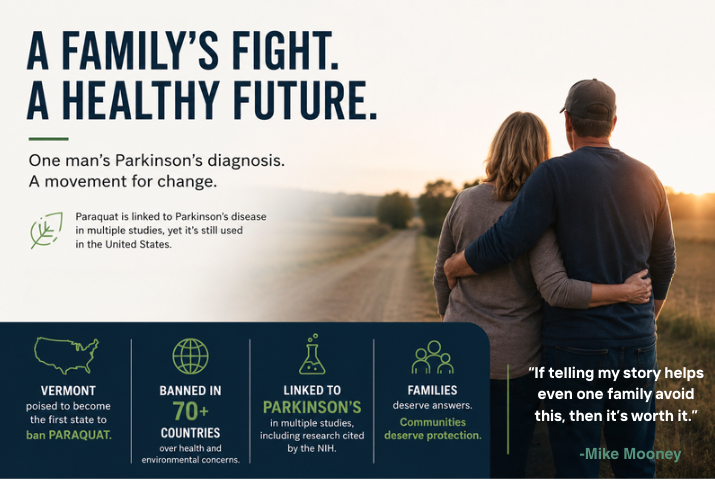
Family's Warning Paraquat Danger
Mike Mooney’s Diagnosis Is Raising New Questions About a Herbicide Still Used Across the United States Despite International Bans
NEW YORK, NY, UNITED STATES, May 24, 2026 /EINPresswire.com/ -- Mike Mooney spent years spraying herbicides while working landscaping and grounds jobs as a teenager and young adult. He was healthy, active, and had no known family history of Parkinson’s disease.At age 49, he was diagnosed with the progressive neurological disorder anyway.
Now, as Vermont moves toward becoming the first state in the nation to ban paraquat, a widely used herbicide linked in multiple studies to Parkinson’s disease, Mooney and his family are speaking publicly about the question that continues to haunt them:
Could this have been prevented?
On May 13, 2026, Vermont lawmakers passed bipartisan legislation, H.739, that would prohibit paraquat use statewide. The bill now awaits action from Governor Phil Scott, who has until May 26 to sign, veto, or allow the legislation to become law without his signature. If enacted, Vermont would become the first state in America to ban paraquat.
As Vermont stands on the verge of becoming the first state in the nation to ban paraquat, momentum is building elsewhere. Lawmakers in New York, New Jersey, Pennsylvania, and several other states are advancing similar legislation amid growing scrutiny of the herbicide’s potential health risks. In New York, the Assembly version of the bill, A.10074A, has advanced to the floor calendar, while the Senate companion measure, S.9094A, remains under consideration in committee.
For the Mooney family, the issue is not political. It is personal.
Mooney says he spent years handling herbicides during landscaping work in high school and college. He had no known genetic predisposition to Parkinson’s disease. Today, he lives with a condition that researchers have increasingly associated with chronic paraquat exposure, particularly among agricultural workers and chemical applicators.
“My life changed forever,” Mooney said. “The hardest part is wondering whether the chemicals I worked around when I was younger played a role in what happened to me.”
Mooney now writes The Impatient Patient for Parkinson’s News Today and has become an advocate for Parkinson’s awareness, research, and prevention.
His wife, Marcy Mooney, an elementary school principal and mother of four, says the diagnosis transformed their family overnight.
“You go from building a life together to suddenly wondering what the future looks like,” she said. “No family should have to live with the uncertainty of whether an exposure like this contributed to so much suffering.”
Scientific concern surrounding paraquat has intensified in recent years. Multiple studies have associated long term exposure to paraquat with elevated Parkinson’s disease risk. Some research cited by the National Institutes of Health found paraquat users were approximately 2.5 times more likely to develop Parkinson’s disease.
Paraquat remains legal in the United States even though more than 70 countries, including China and members of the European Union, have banned the chemical because of health and environmental concerns.
In 2024, a manufacturer funded study submitted to the Environmental Protection Agency found paraquat could volatilize and travel through the air for miles under certain conditions. Public health advocates and researchers say the findings raised additional concerns about potential exposure risks extending beyond agricultural workers to nearby communities.
Concerns surrounding paraquat extend beyond Parkinson’s disease. Some studies have also examined potential associations between paraquat exposure and several forms of cancer and other serious health conditions.
Despite growing scrutiny, paraquat remains widely used in American agriculture, with approximately 10 million pounds applied annually across the country.
Mooney says he is sharing his story because he does not want other families to face the same uncertainty his family has endured.
“If telling my story helps even one family avoid this,” he said, “then it’s worth it.”
AVAILABLE FOR INTERVIEWS
Mike Mooney — Parkinson’s patient, advocate, and columnist for Parkinson’s News Today, where he writes The Impatient Patient. Diagnosed at 49 after years of herbicide exposure during landscaping and grounds work.
Marcy Mooney — Elementary school principal, mother of four, and Mike Mooney’s wife, speaking about the impact Parkinson’s disease has had on their family.
Ray Dorsey — Neurologist, researcher, and co author of Ending Parkinson’s Disease, focused on environmental contributors to the growing Parkinson’s crisis.
Sarah Teale — Emmy nominated documentary filmmaker and producer of HBO investigative documentaries. Her film Where the Sweet Birds Sang examines clusters of Parkinson’s disease cases in rural farming communities.
Representatives from the Environmental Working Group and End Chronic Disease are also available for additional scientific research, policy analysis, and public health commentary related to paraquat exposure.
Christina Pascucci
End Chronic Disease
christina@endchronicdisease.org
Legal Disclaimer:
EIN Presswire provides this news content "as is" without warranty of any kind. We do not accept any responsibility or liability for the accuracy, content, images, videos, licenses, completeness, legality, or reliability of the information contained in this article. If you have any complaints or copyright issues related to this article, kindly contact the author above.
